
An Erie feeling
Week 69 - Mark and Ellie earn their Buffalo wings while cycling along the first half of the Empire State Trail in New York State

The myths and legends surrounding Nikola Tesla, the Serbian inventor and futurist, have always fascinated me. Tesla was a heavy dude. He regarded the creation of electricity by extracting and burning fossil fuels as “sinful waste.”
Not only did Tesla pioneer environmentally friendly ways to generate electricity, he believed it was possible to create a source of inexhaustible energy that would provide free electricity for mankind without damaging the planet.
He was so far ahead of his time that he was like a DC comic character: a skeletal Eastern European who could channel the immense electrical power of the earth for the benefit of humanity. He even had a comic character’s name. Damn that Musk rat for stealing it.
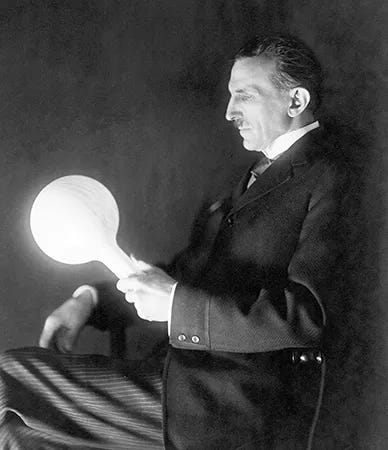
In a move taken straight from a science fiction comic strip, in the 1930s Tesla claimed to have invented a death ray that he christened “Teleforce.”
Tesla never built Teleforce but he said it could fire 100 billion watts of electricity in a beam that measured one-hundred-millionth of a square centimetre, capable of shooting down an aeroplane 400km away. That’s some Charles Xavier shit right there. Naively, he imagined Teleforce would be a peace-keeping device.
Tesla was a dude who built a 20 storey tower in Colorado that gathered huge electric charges and shot lightning bolts into the sky, while making thunderous booms that were audible 25km away. When he said he could make a death ray, people paid attention.
The pioneering electronic advances made by Tesla were used to develop fluorescent lighting, radio and television broadcasting, MRI scanning and x-rays. Although Marconi is credited with the invention of the wireless telegraph and radio systems, much of the technology used for Marconi’s transmissions were based on Tesla’s patents.
In 1909 Marconi received the Nobel Prize in Physics for developing the first practical wireless telegraph system. In 1943 the United States High Court ruled that Tesla had actually invented systems credited to Marconi. This ruling came too late for Tesla who had died penniless and alone in a New York hotel a few months before the ruling was made.
When Tesla died, a United States government agency seized all of his belongings, papers and personal effects. To this day there are theories and conjecture about what might have been in those papers and how it could have been used.
*Insert a Tesla technology conspiracy theory of your choice here*
We were standing in a park in North Tonawanda, beside the Niagara River, with the legendary falls behind us, and a full size Tesla coil in front of us. That coil is one part of a trail of monuments along the river that commemorate Tesla harnessing the power of Niagara Falls to create the world’s first commercial AC power generating plant. The thunder and lightning in the distance felt appropriate.
Tesla had envisaged and designed the power station in his head decades earlier, as a young man, when he saw a picture of Niagara Falls. Building that hydroelectric power plant to provide free electricity was the dream that brought him to America.
Tonawanda is on the United States side of the Niagara River. We had made it across the border into America on our bicycles for a second time.
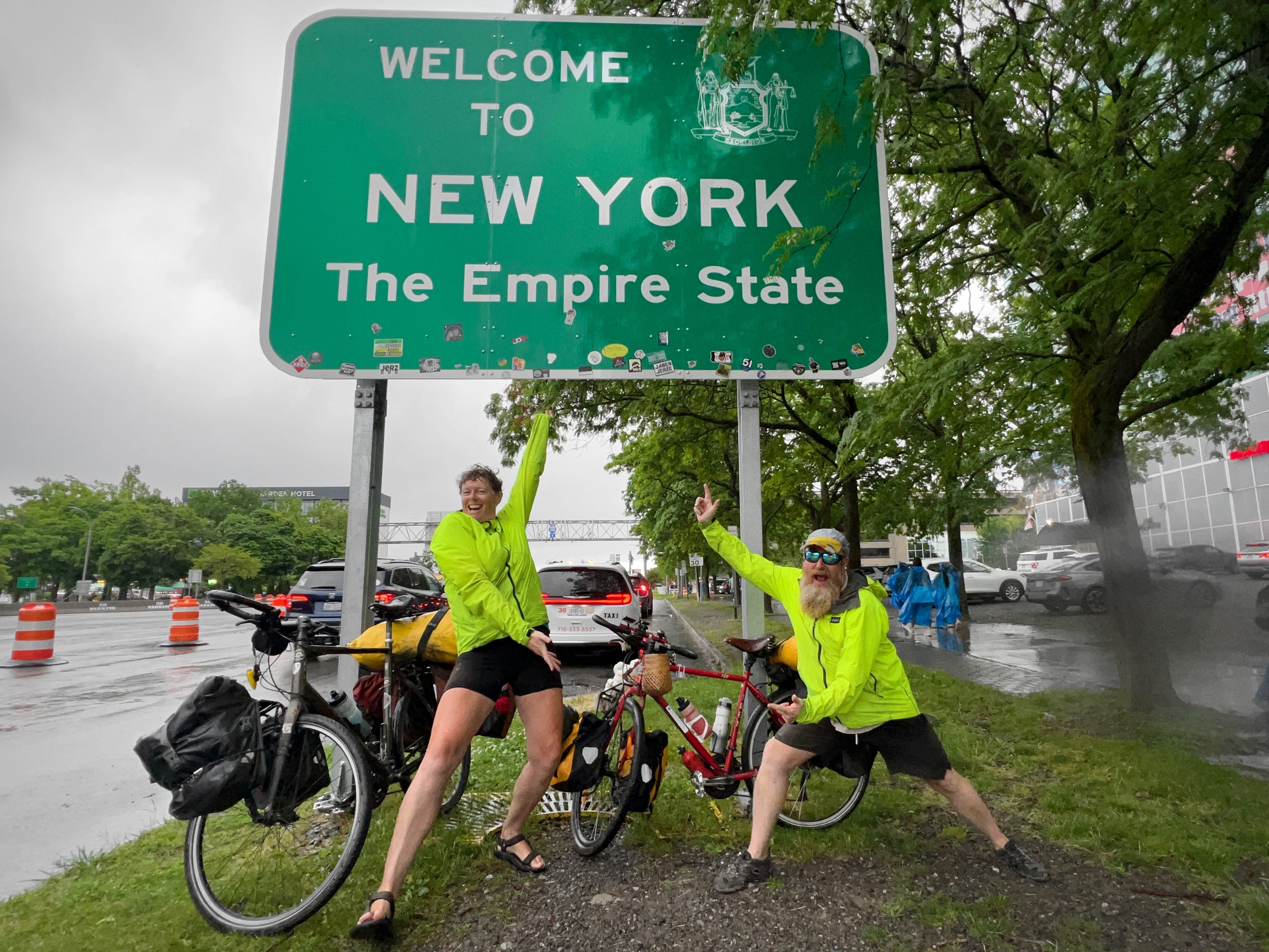
Contrary to much of the online hype about US border control checking your mobile phone and social media history before allowing you into the country, we found both crossings to be smooth and straightforward. Even though Ellie had smuggled some contraband fruit into the country at our first crossing. Shhhh! Don’t tell ICE about Ellie’s bananas.
Having crossed more than 20 international borders on our bicycles during this journey, some of them twice, we’ve formed the opinion that the bicycle is the best vehicle for international drug smuggling. We haven’t had our bags fully searched at all on this journey.
Okay, you’d be a very slow drug smuggler, with a very limited cargo capacity, but you would never have your bags searched. Escobar on an e-bike may be less wealthy, but he’d have been a lot more healthy, ie, not riddled with bullets.
Just before reaching that park in Tonawanda, the storm clouds broke and rain cascaded from above as we stood on the border crossing bridge that straddles the Niagara River. Canada is on the western side of that bridge and the United States is to the east. Folks from each country had told us the view was better from their side.
To say that there’s a competitive edge to relations between Canada and America at the moment is an understatement akin to saying England were a little disappointed at being ejected from the FIFA World Cup by Argentina, and ever so slightly miffed about that Falklands banner the winning Argentine players stood with after the game.
A country’s sense of self gets tangled up in some weird stuff, how best to view a waterfall being just one example. In relation to that view of Niagara Falls, I can reliably inform you it’s 1-0 to Canada.
An American border control officer came out of his hut and ushered us to skip ahead of the queue of cars, to get out of the rain. He was friendly and helpful.
The next border control officer who checked our passports asked us a few canny conversational questions that could have had political overtones.
“What are you gonna do for July 4th?” he enquired casually in a thick New York accent.
“We’re planning to harness the power of Tesla’s Death Ray to destroy the imperialist infrastructure of the American capitalist system and establish a new world order,” we most definitely did not reply.
“That’s it. You’re all set. Welcome to America.”
He probably knows that the plans for the death ray are safely locked up in Area 51 anyway.
A New York State of mind
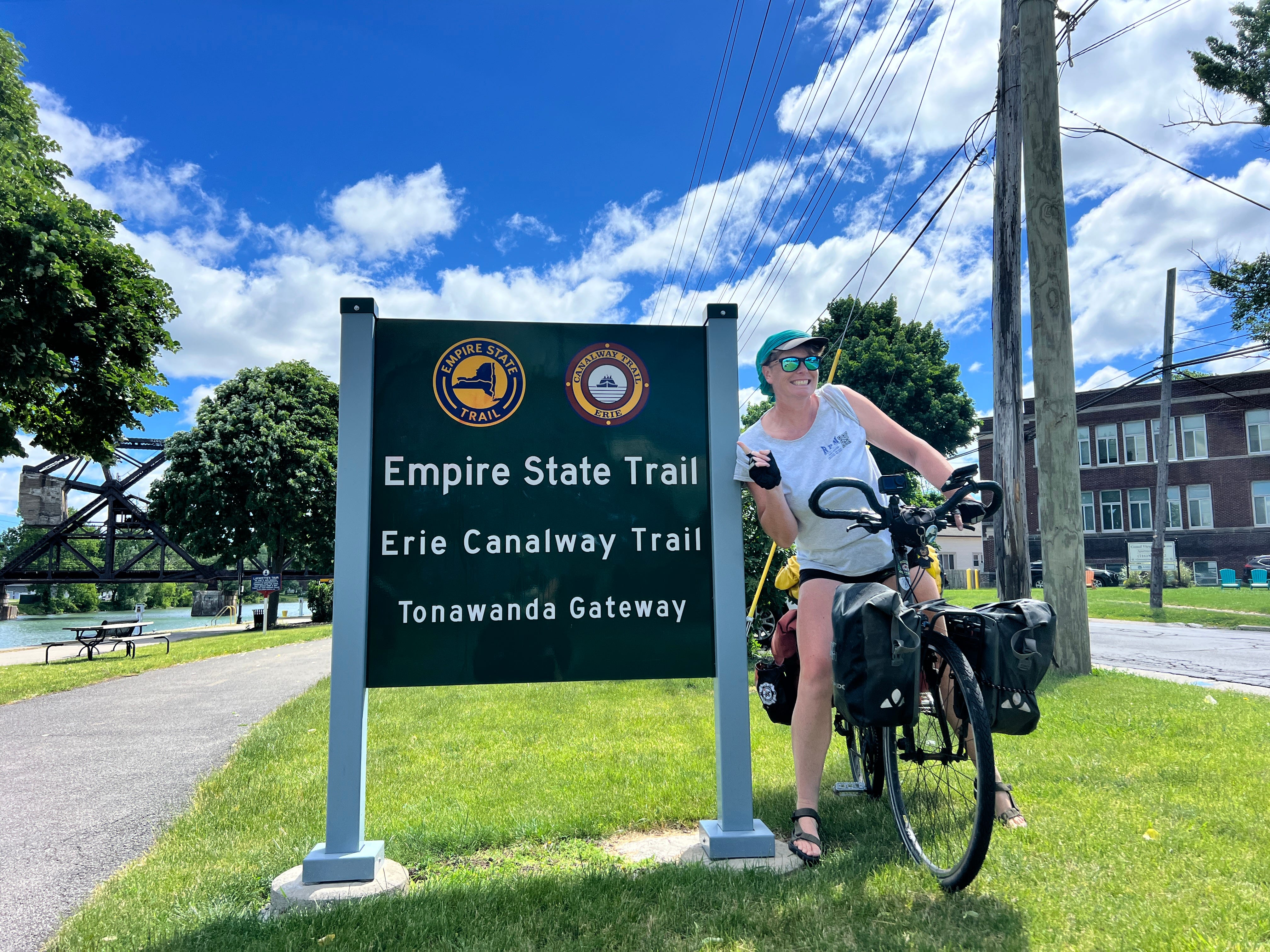
The Erie Canalway in New York State runs for 584km from Buffalo to Albany. That would be the route we would follow for all of week 69 of our attempt to circumnavigate the globe on our bicycles.
In Albany, that path joins the Hudson Valley Trail that continues all the way from there to Battery Park at the southern tip of Manhattan. Joined together, these two routes form the Empire State Trail, about 1,000km of bicycle track, mostly off road, running from Buffalo to New York City.
We’d decided to cycle the whole thing. It wasn’t the most direct route, but for two world-wandering cyclists, it’s the most scenic.
We hadn’t originally planned to cycle straight into New York City, initially thinking that cycling right into the most densely populated area of the United States would be a ridiculous thing to do. An old-timer in Montana backed this theory up for us.
“Where you folks headed?” a gnarled old cowboy had asked us when we he encountered us out on the Western Plains.
“We’re hoping to reach New York City for July 4th.” The cowboy stopped dead in his tracks, tipped his hat back, and got deathly serious. “You do know there’s going to be a heck of a lot of people there, right?” The thought of New York, let alone New York on the 4th of July, sounded hellish to a Cowboy from Big Sky country. He shook his head ruefully, feeling genuinely sorry that we’d have to endure such a thing.
My cousin Helen cycled this trail last summer, and she posted a video of her travels. I showed the video to Ellie and we’d changed our plans, deciding that cycling across the Brooklyn Bridge was something we definitely wanted to do. Anthrophobic cowboys be damned.
That Tesla monument in Tonawanda felt like a totem, placed there to let us know that we were entering a whole new phase of our journey, and to also let us know that a lot of shit went down along the trail we were about to follow.
Rust in Peace
The Erie Canal once provided a thriving and lucrative economic link between the Atlantic Ocean and the Great Lakes, precipitating a financial boom in New York State and City.
When the canal opened in 1825, freight costs were slashed, shipping times went from weeks to days, and industry along the canal burst into life.
Towns along the Erie waterway, such as Syracuse and Rochester, became industrial hubs. By 1830, New York was the largest port in the United States. By 1860, two thirds of all American imports passed through New York Harbour and the Erie Canal. The financial dealings around imports, exports, and insurance made Wall Street the financial capital of America, and saw New York leapfrog Boston as the most economically important city in the United States. This canal had impact.
The rise of the railroad at the end of the 19th century, the opening of the St. Lawrence Seaway in 1959, and the advent of trucks and highways killed the canal as an economic entity. The hulking remains of cranes, silos, and factories along the waterway are the decaying monuments that remain, a reminder of the long gone glory days of the Erie Canal as a thriving industrial artery.
Those disintegrating industrial remnants gave rise to this part of America, and other dilapidated adjoining areas of the east coast, being christened The Rust Belt.
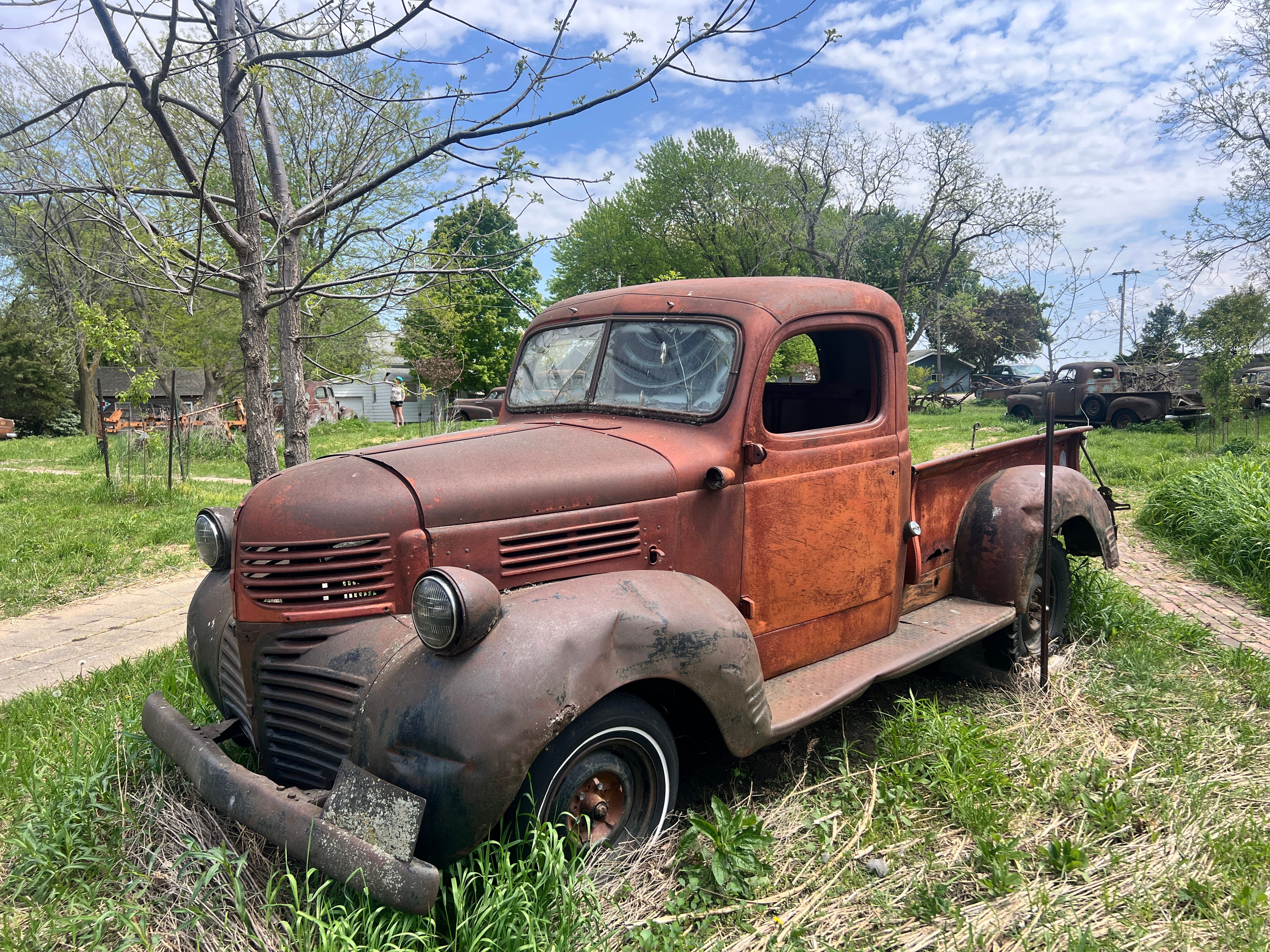
As we made our way out of the park and through the town of Tonawanda, many of the businesses had Italian names over the doors, and some made playful reference to the Mafia.
“Swimmin’ with the Fishes” in the same font as The Godfather film franchise adorned the showroom of a swimming pool services company. All those references served as another indicator that shit went down on the trail we were about to follow.
For example, in 1968 the naked and mutilated body of Freddy “The Fox” Aquino was found on the canal path we were following. There was evidence he had been tortured and acid had been poured over his face.
Freddy’s murder was one of three similar gangland hits in Tonawanda in the same month of that year. I was on the lookout to see if there was a car battery store named after him.
This may not have been the first time we’d cycled a path that a notorious naked gangland figure was found dead on, but it’s definitely the first time we’re aware of it. Thankfully we didn’t have to pitch our tent over the decaying corpse of Silvio “Campstove” Callieri or Mo “The Mallet” Manetti. We were staying under a roof in Buffalo with the Irish mafia.
A couple of weeks earlier we’d been interviewed on Cork’s RedFM, and we put a shout out for anyone with any contacts along our east coast route who might be able to hook us up with a camping spot or bed. We knew that high summer on the east coast was going to be a little trickier for camping than the mid-west had been: a tent pitch with no services at a campsite near Niagara was $175 per night. There are still a few gangsters knocking around this neck of the woods.
The Irish community at home and here in America responded to our radio call-out. Through listeners, their friends, and friends of friends, we were inundated with messages and offers.
Somehow Damien O’Halloran, an Irish helicopter pilot based in Massachusetts, got wind of our journey, he told his buddy Derek in New York State, and Derek let Padraig and Shannon in Buffalo know we were passing by. Convoluted, but it transpires that Irish folk in America really look out for each other.
Shannon and Padraig welcomed us into their home and made us dinner. Shannon, born in America but with an Irish father, echoed a sentiment that my Australian-born cousin Helen shared when she came to visit us in Seattle: Irish people talk a lot!
Ellie, Derek, Padraig and me drank lots of Barry’s tea and stayed chatting for hours. Shannon tapped out for bed long before we started to slow down.
Padraig is the epitome of the American dream. He came to America as a carpenter, working on building sites, through a series of trying circumstances he ended up going back to school, and he now works as an attorney. Would he have become an attorney if he’d stayed in Kiltimagh, Co. Mayo?
It was great to get an insight into how things are for some of the Irish people who come to America to make a life for themselves.
Padraig told us about how GAA is an important part of economic life here. Business folk and developers from the Old Sod sponsor local GAA teams in the US. They fund prominent and talented GAA players from Ireland to come over to play for these local clubs. Why would they do that, is it purely for a love of the games?
Padraig told us that when he was working for a building contractor he was approached by a local club to play football for them. He declined the offer on the basis that the jobs they were working on were primarily for a company that sponsored a different team. The next week his boss got job offers in from the company that sponsored the team that wanted Padraig to play for them.
As well as the prestige of winning, if a sponsor is associated with a successful club that attracts successful athletes to it, it builds a pool of labour and talent associated within the sponsor. The sponsor benefits in terms of business generation and general networking. It seems that GAA clubs in America have long been used as a form of physically fit freemasonry.
I thought back to the GAA players who I knew who had emigrated to the United States for a year or two. It had never occurred to me that they were being paid extra to play for a local American club as some form of high performance HR honey pot. Hopefully none of them ever ended up in the boot of a Ford Fiesta on some waste ground after losing a match.
Hail fellow well met
There was some rain and heavy winds during the initial stages of our jaunt along the canal path, but even the weather wasn’t enough to detract from the enjoyment of the trail. It was a blessing to spend days on dedicated bicycle lanes, with no motorised traffic, and no need to consult a map or navigation app. The Empire State Trail quickly began to feel like a little holiday.
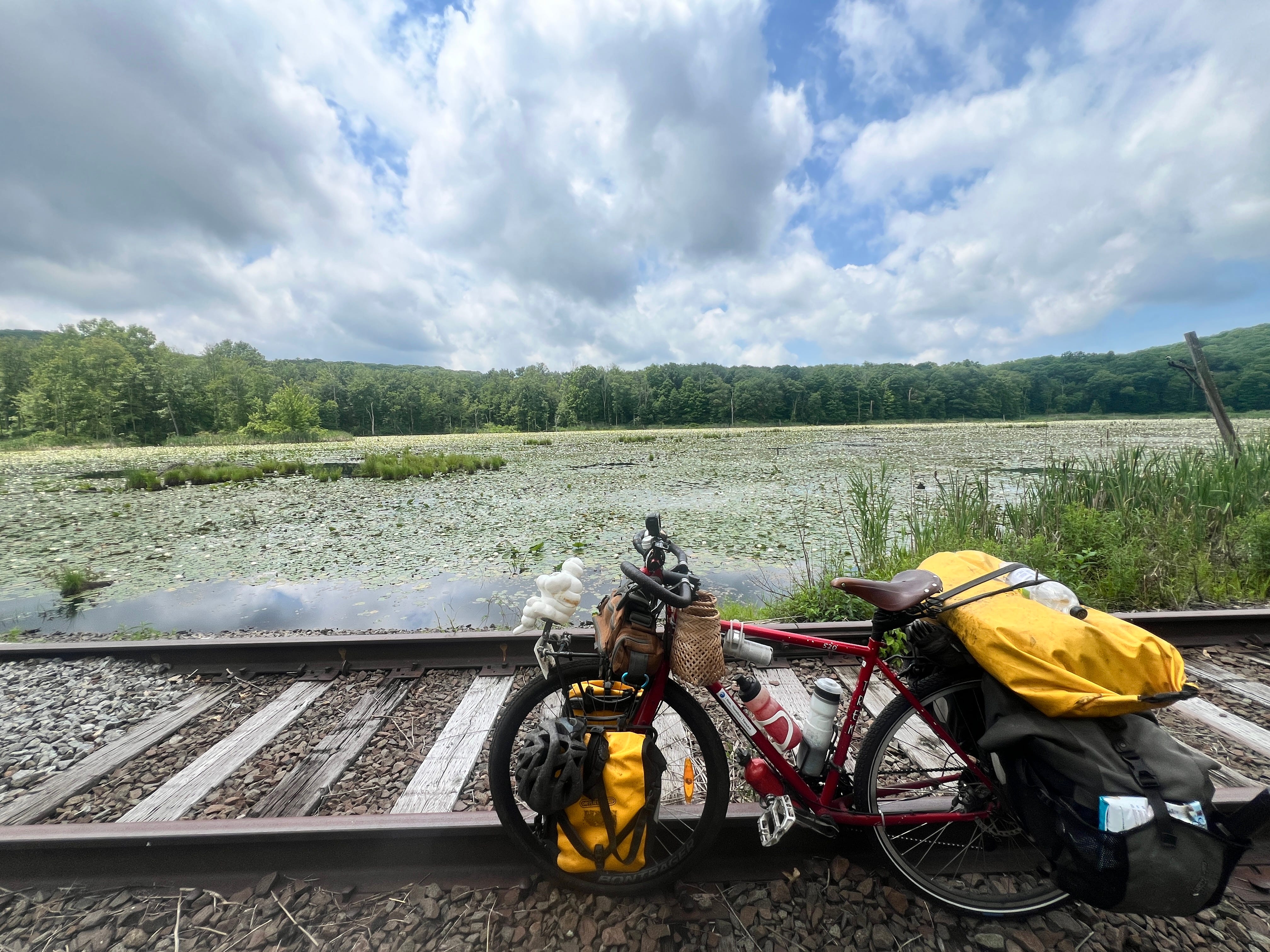
We were shaded from the heat of the sun and the worst of the wind by oak, hickory, sycamore and willow trees. Tiny chipmunks darted dangerously beneath our wheels. Squirrels leapt from the path, trying to grab onto trees, but not always hitting their mark. Huge, prehistoric-looking snapping turtles nested at the side of the path, while we dodged terrapins and snakes that used the trail to catch some rays. I had not expected New York State to provide such a beautifully bucolic backdrop to our bicycle journey.
Our blissed-out holiday mode was enhanced further still by the lack of hills. Heaven! It made sense that we’d meet more fellow bike tourers on this trail than we have met anywhere else in the world.
We chatted with three very happy and tattooed young lads who had left New York City over a week earlier, heading for Buffalo on their big summer bicycle adventure. They gave us a tip for a church to spend the night in further down the trail.
We pootled along with a guy celebrating his 60th birthday, who was cycling to Albany with his brother and nephew. We spent a day in the company of Mark, a retired meteorologist, heading for Syracuse. They all added to the light-hearted holiday vibe we were feeling on this section of our journey.
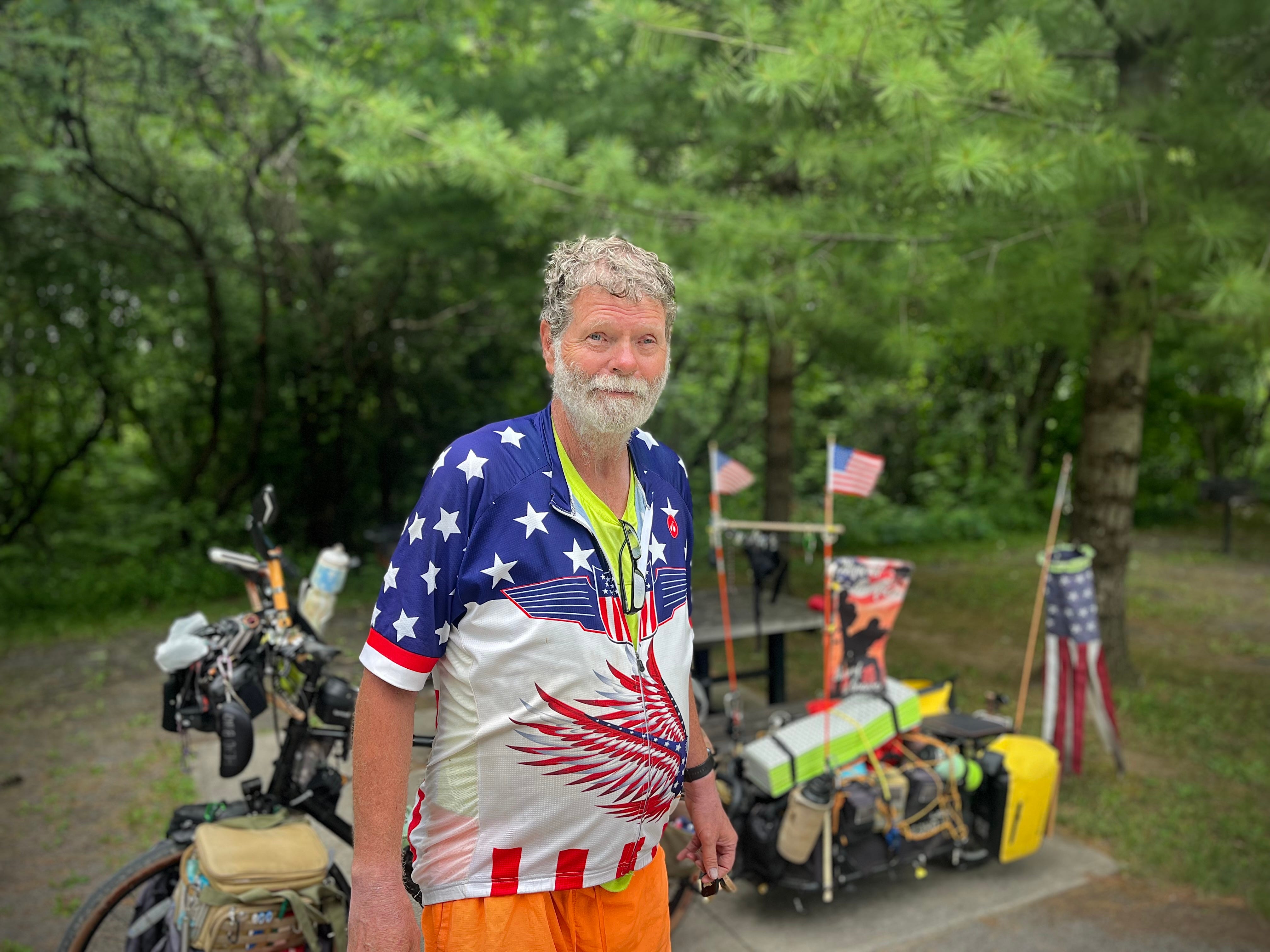
George, an army veteran on a fundraising cycle to Washington DC, was a sobering reminder of the risks of bicycle touring. He was back on the road having recovered from being hit by a car while on his bicycle. He spent seven months in hospital, four of which were spent in a coma. We camped beside him for a night.
Camping along the canal is simple and straightforward. Many of the lock areas have designated spots for tents, often with a firepit or barbecue alongside. Almost all the locks have portaloos.
At one lock, one of the portaloos had been blown over by the wind. We hoped no one was in there at the time, and we put a price on how much we would need to be paid to clean up the mess that an overturned portaloo on a busy trail would create. $720, please.
Although the artefacts of the Rust Belt are evident all the way along the canal, State authorities have done a decent job switching these amenities to leisure use. Pleasure boats populate the waterway, cyclists tinkle merrily at each other as they pass on the paths, and pretty overpriced coffee parlours abound to keep everyone peppy.
The canal water was not clean enough to entice us in for a swim, but there are plenty of young lads who find it difficult to resist the lure of the murky waters when the sun comes out. They can be seen jumping off an assortment of giant rusting structures. That said, we did need to wash and rinse ourselves off once we pitched camp at the end of the day’s cycling.
More than once we cleansed ourselves with the waters of the Erie canal. At Lock 30, near the town of Macedon, we sat on a floating jetty in our underwear, legs dangling over the edge into the canal, like something from a Mark Twain story.
We used our camping pots to pour canal water of questionable quality over our heads. Then we lathered up with shower gel and repeated the pot process to rinse off the suds. It sounds far from idyllic, but we loved it, laughing our heads off at the freedom and absurdity of it all while throwing pots of water at each other. It’s simple moments like this that make this journey so wonderful. The time, space, and childlike abandon that this adventure has afforded us to goof around like this is something we’re very conscious of and thankful for.
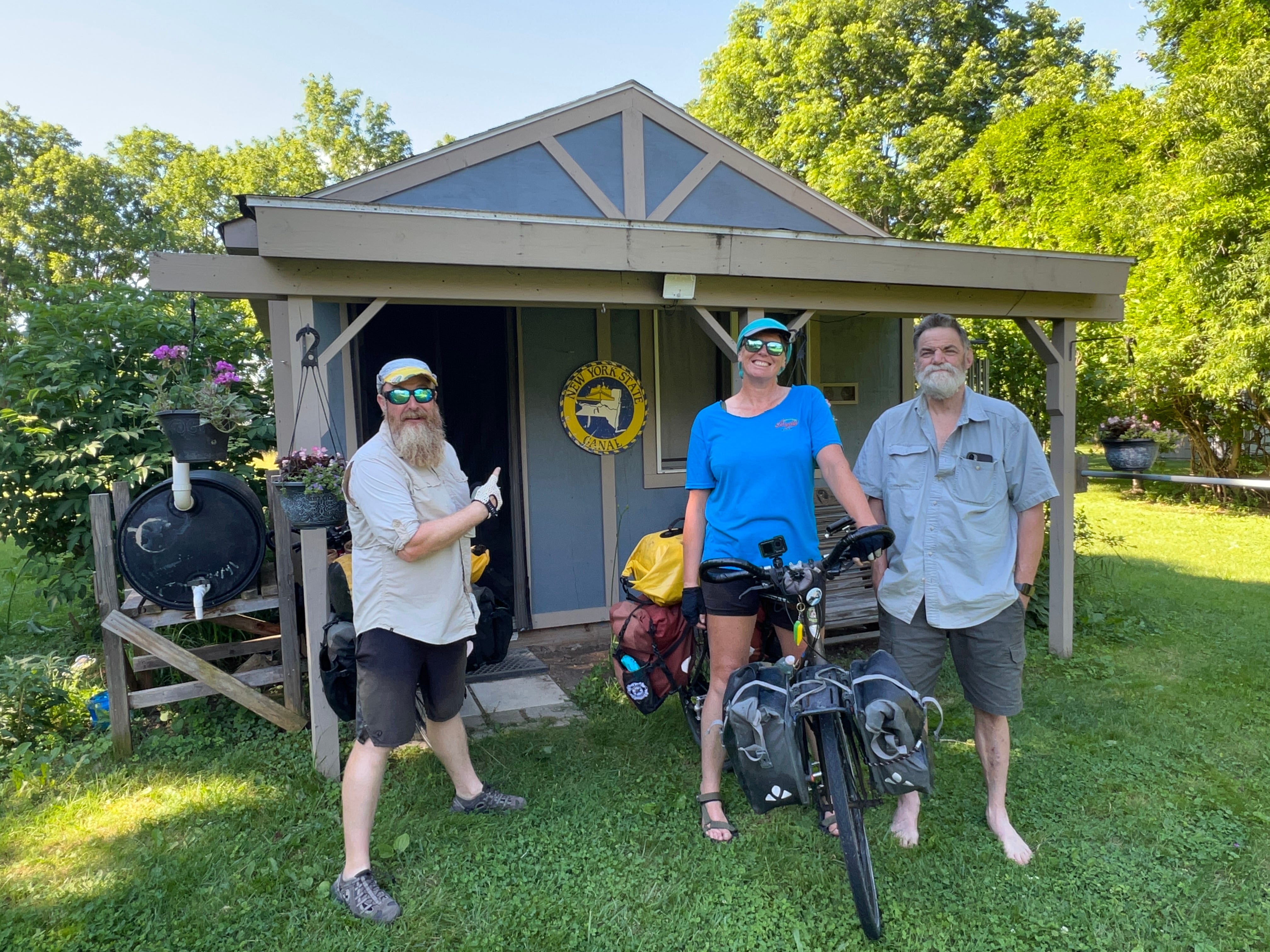
In Port Byron, we stayed with WarmShowers hosts Mike and Mary Riley. Mike is the President of the American Canal Society and he’s a mine of information about the history of the Erie canal, as well as being a collector of vintage bicycles, skillets and lanterns. Mary works as a chaplain in the local hospital. Talking with both of them was incredibly interesting.
Mike told us how it was mainly Irish labour that dug the canal with shovels and picks. They were the cheapest and most expendable labour force at the time.
Genesee Fever, a catch-all name for malaria and cholera, was rampant among the workers digging in marshy areas. If the fever didn’t get them, collapsing canal walls and gunpowder blasting would. It’s not known exactly how many died, nobody bothered keeping a record, but it’s estimated to be in the thousands. Many of the men were buried in unmarked graves along the canal banks we were cycling over.
It was said that for every six feet of canal, one Irish labourer died digging it. Near the town of Macedon, where we’d washed and camped for the night, there is a mass grave of 26 unidentified Irish labourers.
In a letter to his sister in Ireland in 1819, a canal labourer wrote “I don’t know, dear sister, if any of us will survive, but God willing, we will live to see a better day. Six of me tent mates died this very day and were stacked like cordwood until they could be taken away. Otherwise, I am fine.”
Indentured servitude and the desperation of the huddled masses was capitalised upon. The Erie Canal created a boom that set Wall Street up as a financial capital of the world, but it came at a human cost.
The price of the canal was also paid by the First Nations people living in the area. The Mohawk River is one of many rivers that feeds the Erie Canal. We were excited to cycle along its banks, passing through the ancestral home of the People of the Flint. The water that fills the Erie canal was diverted away from tribal lands.
Take me to church
For miles on either side of Lock 16, the Erie Canalway gets about as beautiful as any dedicated cycle path we’ve ever experienced. At Little Falls the route follows an old railway line, passing through a canyon that was blasted out of solid rock.
Here at high summer the trees create a canopy that forms a tunnel over the sheer stone walls. The swaying dappled green light creates a sylvanian mirrorball effect for the deciduous discotheque we found ourselves pedalling through, with MC wood thrush on the mic.
When we reached Sprakers Reformed Church we were spent, but elated from a beautiful days cycling. This was the church the three young lads from New York told us about.
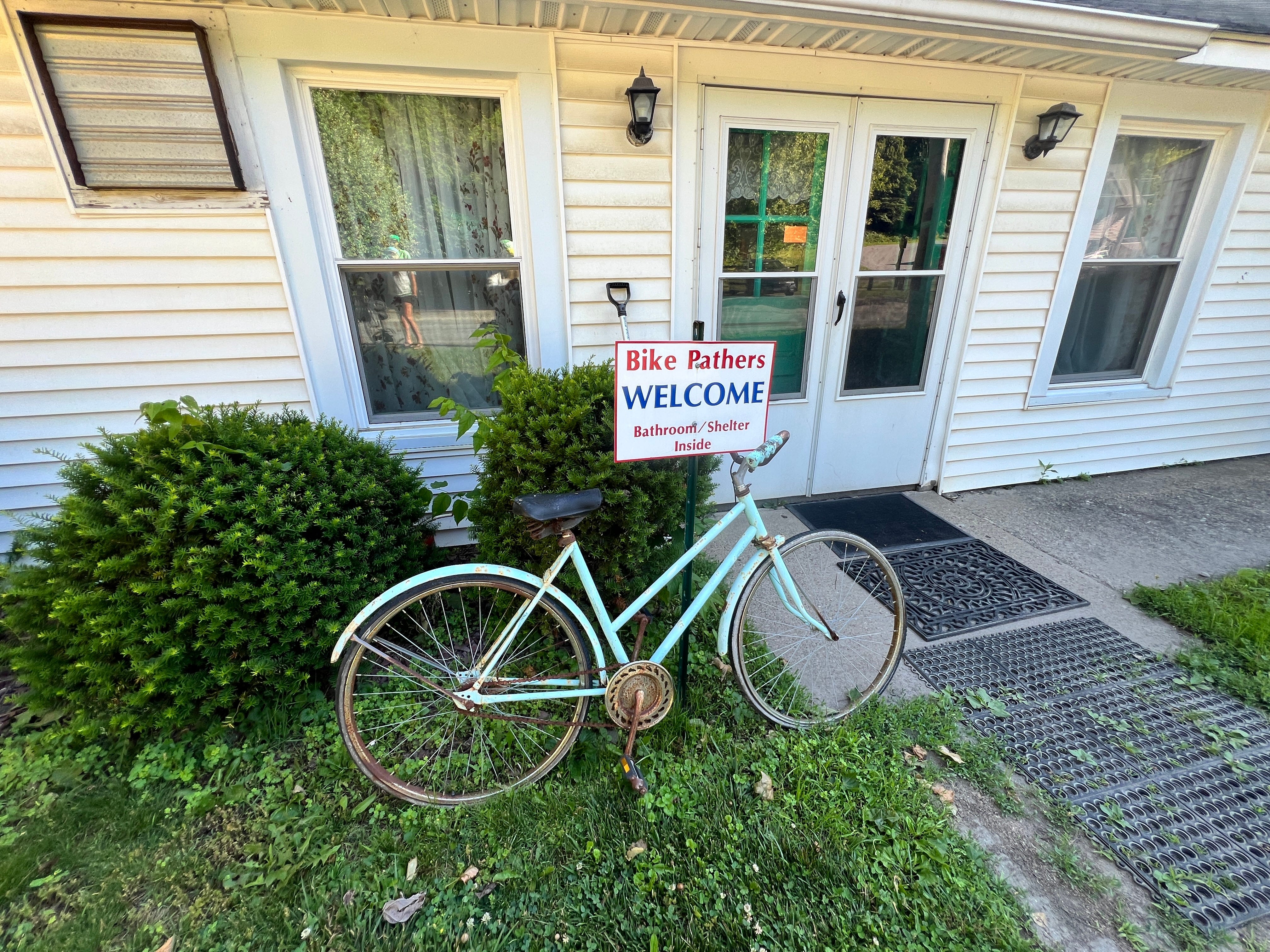
The congregation at Sprakers used to leave out a cooler of water for cyclists that passed by their door. It was so well used that they gradually left more things out for passing cyclists, until eventually they decided to leave the church and adjoining hall doors open 24/7.
Inside the hall there’s boiling water, tea and coffee, snacks, a fridge with cold drinks, porridge, tools, spare parts, a bathroom with running water, and inflatable beds. You don’t need to book it or tell anyone you’re there, you just leave a donation to the church if you feel like it. We wondered if an open resource like this would be used or abused if it were on a busy cycling trail in Ireland.
By the time we got to Albany, we were ready for a rest day. The terrain and surroundings were beautiful, but there had been some seriously strong winds along the way. In the town of Lyons a wind whipped around us as we approached a bridge, a lady screamed as she lost control of her car door, and the gust almost knocked us off our bikes. It was only later that evening, during a power outage, that we found out we’d cycled through another tornado warning.
Kees and Hilary, our WarmShowers hosts in Albany, had kindly agreed to let us stay for two nights. We were looking forward to a full day’s rest away from the bikes. Yet again we were blown away by the generosity and hospitality extended to us by complete strangers.
Kees has spent most of his life in The Netherlands and New Zealand, but he now works as an assistant headmaster in a secondary school in Albany. Hilary works with New York State Parks, and has a passion for ecology. The array of interesting and kind people who we’ve stayed with while on this journey is mind-boggling.
Hilary and Kees are part of a respite foster care program, and we were delighted to get a chance to go out for a cycle with Noah, who stays with Kees and Hilary for a couple of days each week. Noah is a great kid who was curious about our journey and seemed to particularly enjoy hearing about our experience of toilets of the world when he attended our talk at the Irish American Heritage Museum in the city. In fairness, it’s a colourful subject matter.
One of many things that we will miss when we finish this cycling journey around the world is the kindnesses we have been surrounded by almost every day. The new places and people we experience have reaffirmed our faith in humanity, and steeping ourselves in that kindness on daily basis is both heartening and addictive. I’ve been wondering how I’ll adjust to days when I don’t experience that level of heartwarming generosity.
It’s taken a while to address that concern, but the appropriate response is a simple one: if I carry forward that generosity and kindness by performing it in my everyday life I’ll continue to experience it, but from the other side. A gentle reminder of carrying the kindnesses forward was sitting atop a piano in the home of one of our hosts.
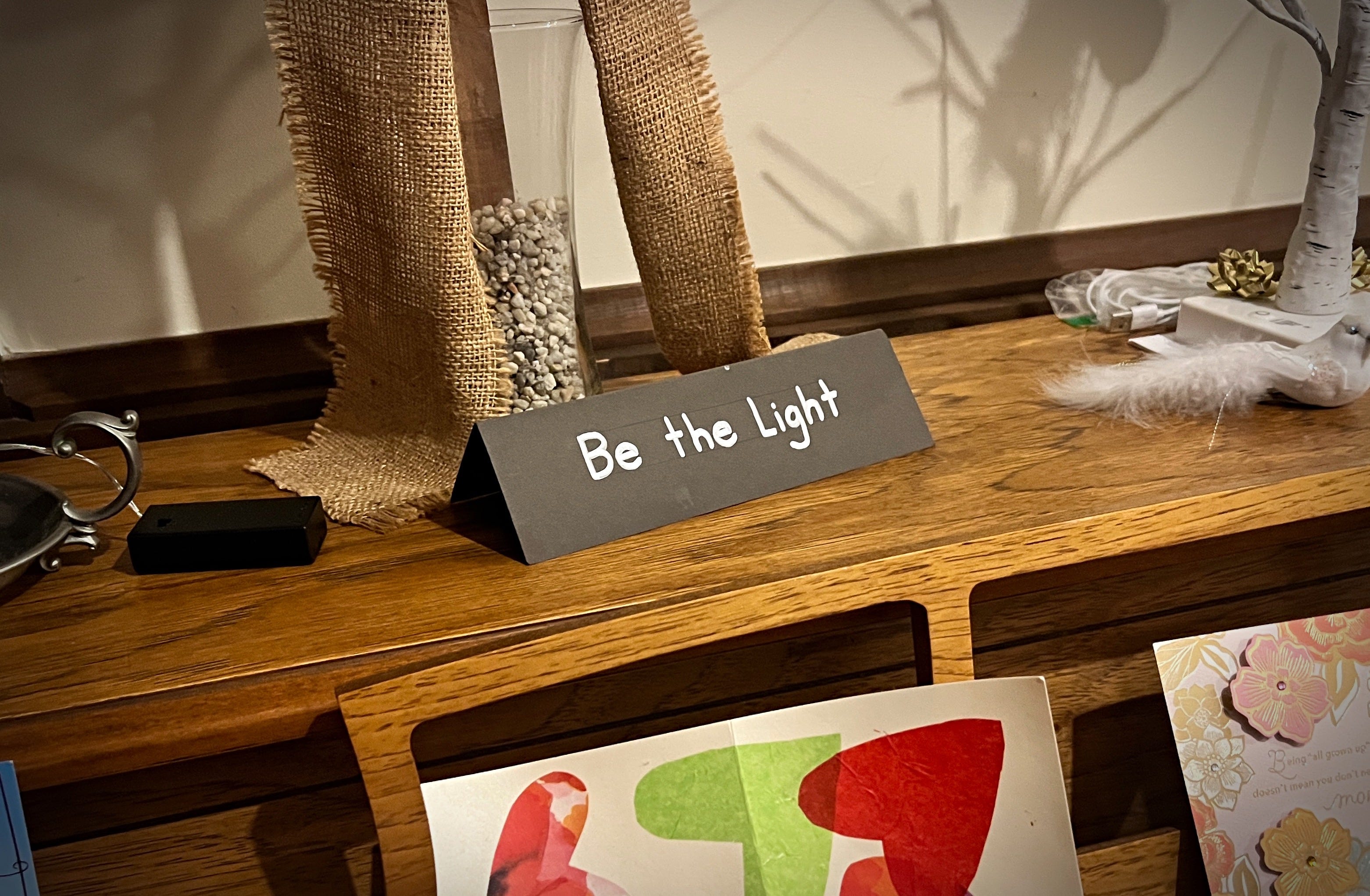
In the city of Albany we sat in the window of a small cafe, grabbing breakfast before striking out for the Hudson Valley River Trail.
A guy pulled up on an e-bike with a large Bluetooth speaker attached to the front of it blaring out the unmistakable boom bap of 90s hip hop. The bicycle rider came into the cafe, ordered some pancakes, then went back out to his bike, which was parked right in front of the cafe window. He then began selling drugs. Pancakes ain’t free.
As we were about to leave, a heated discussion had broken out between the drug peddling pedaler and a customer, who was also on a bicycle. Our bikes were locked right beside them and I was bracing myself for some diplomatic manoeuvres to navigate a way around whatever argument they were having. I presumed it related to either the cost or quality of what was being exchanged. Possibly both.
As I approached the pair, one of them shouted, “Nah man! I ain’t never putting tubeless tyres on that bike. I don’t care what you say.”
The heated discussion I’d seen being acted out was based around the merits and disadvantages of having tubeless tyres on your bicycle. “If it’s any help, we’re using tubes,” I pitched in as I approached our bikes. “See, I told ya!” the most animated gent happily threw in.
They asked where we were going, and they were suitably impressed when we told them. “I got the same bear spray as that,” one of our new-found friends told me as he pointed at the can attached to my crossbar. “Yeah, and around here I don’t keep it for bears,” I said with a grin.
“ME TOO!” he shouted back, laughing.
They were very curious about how we were crossing borders, one of them asking if he could do that without a passport. We told them about the ins and outs of it.
“The surprising thing is that we have never had our bags searched at any border crossing, so it turns out that traveling by bicycle is a good way to smuggle things,” I said, punctuating the sentence with a theatrical wink. The quieter of the two gents touched his nose, pointed at me with an outstretched arm, and nodded slowly and sagaciously.
What’s in a name
As we made our way towards the Hudson River I wondered who the Hudson it was named after was. Unsurprisingly, it was named after an English explorer and colonialist who worked for the infamous East India Company.
The river was known to First Nations people by a few different names depending on which native language was being used. My favourite is Muhheakantuck, which translates as “the river that flows both ways.” This name references the tidal nature of the Hudson, and for us that tidal nature meant we were getting closer and closer to our beloved Atlantic Ocean.
As we cycled out of Albany, along the river that flows both ways, we could feel the inexorable pull of the Atlantic Ocean. I spent the day thinking about the names of important things and what they tell us.
At the start of this week we passed the first ever AC hydro power generating stations in the world, the vision of a benevolent genius. The power stations there now are named after politicians and capitalists.
Two of Marconi’s investors were Edison and Carnegie. It’s thought that these investors helped Marconi get around Tesla’s existing patents. After all, who in their right mind would invest in the work of a lunatic who wants to give away very valuable shit for free?
In this land, Serbian socialists don’t get things named after them. They die alone and penniless and then they get their name co-opted and trademarked by the world’s first trillionaire. Pancakes ain’t free.
Since we are on a roll of quoting from this episode, which was in its entirety a great read, I particularly loved:
‘The swaying dappled green light creates a sylvanian mirrorball effect for the deciduous discotheque we found ourselves pedalling through, with MC wood thrush on the mic’
All sounds fantastic! 💙
I love this Mark - "It’s taken a while to address that concern, but the appropriate response is a simple one: if I carry forward that generosity and kindness by performing it in my everyday life I’ll continue to experience it, but from the other side."
And that one of the original names for the Hudson translates as 'the river that flows both ways'.